To verify a peptide COA, contact the laboratory named on it using details you have found yourself, send it the report number and a copy of the page, and ask it to confirm that it issued that report for that sample with those results. The lab is the only party that holds the original record, so its answer settles the question in a way no visual check can.
This note sets out the five steps, a short enquiry you can adapt, and how to read each kind of reply.
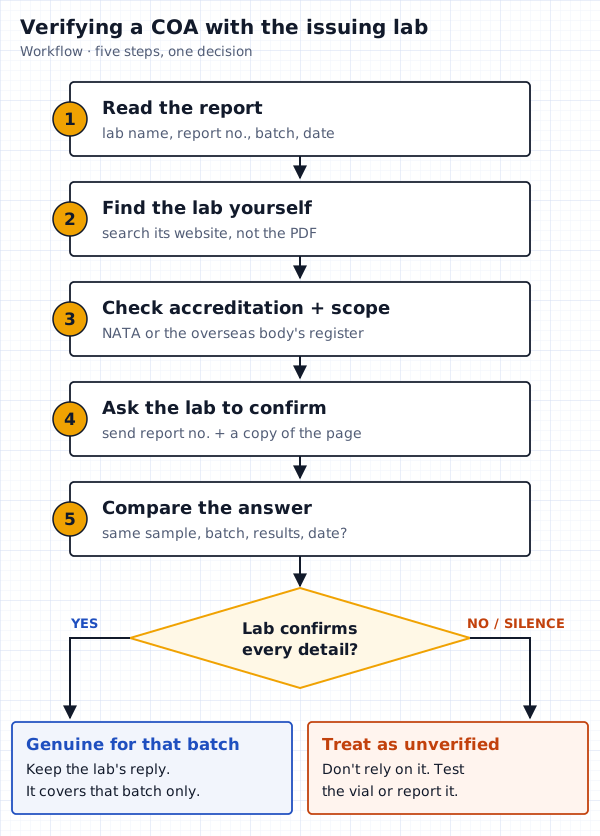
Step 1: pull the identifiers off the report
Before contacting anyone, write down what the report claims. You'll need these details for the enquiry and to compare against the reply:
- laboratory name, address and any accreditation number;
- report or certificate number, issue number and page count;
- sample description, batch or lot number and the lab's sample ID if shown;
- dates received, tested and issued;
- each result with its units and method.
If the document has no report number and no laboratory address, stop here. There is nothing to verify, and the front-page briefing explains why that alone is a red flag.
Step 2: find the laboratory on your own
Search for the laboratory's name and find its website without using any link, email address or QR code printed on the COA. Forgers control the document, so they control its contact details too. Check that the website lists the same street address and phone number as the report.
For an Australian business, ABN Lookup confirms whether an ABN is active or cancelled and shows the entity name and, where available, historical trading names. A mismatch between the ABN and the lab name on the COA is worth noting before you go further.
Step 3: check accreditation and scope
If the report claims accreditation, look it up. For an Australian lab, NATA's Find Organisation search accepts an accreditation or site number and shows whether the facility is active, suspended or withdrawn, with a scope page that lists what it is accredited to do. Look for the technique the report used. NATA states that its endorsement is not permitted on reports of testing outside the scope of accreditation.
For a lab overseas, start with the ILAC MRA signatory search, which lists national accreditation bodies by economy, then use that body's own register. Accreditation doesn't prove a particular report is genuine, but a false accreditation claim proves the document can't be trusted.
Step 4: send a short, specific enquiry
Labs answer clear questions faster. Keep it brief, attach the page, and ask for a yes or no on each point:
Subject: Verification request, report [number]
Hello, I have been given the attached certificate of analysis, which names your laboratory. Could you please confirm whether you issued report [number], dated [date], for a sample described as [sample] from batch [batch], and whether the results shown match your records? I am not asking for any other information about your client. Thank you.
Asking only for confirmation, rather than for the client's details or the full data, makes it easier for a lab to reply without breaching client confidentiality.
Step 5: read the reply
| The lab says | What it means | Next step |
|---|---|---|
| Yes, every detail matches | The COA is genuine for that sample and batch | Keep the reply with the COA |
| The number exists, but the product, batch or results differ | The document has been altered | Don't rely on it; consider reporting |
| No record of that report | Forged, or the wrong lab | Treat as unverified |
| We only discuss reports with our client | Can't be confirmed through you | Ask the seller to have the lab confirm to you |
| No reply | Unverified, not necessarily fake | Follow up once, then treat as unverified |
A confirmation covers the sample the lab received. It doesn't prove that the vial you hold came from that batch, which is the subject of our note on batch COAs versus your own vial.
Why a genuine report can fail a check
Not every mismatch means forgery. Before concluding a COA is fake, rule out the ordinary explanations:
- A reissued report. Labs sometimes correct and reissue a report under a new issue number. Your copy may be an older version; ask which issue is current.
- Missing pages. A seller may have shared only the summary page. The lab's record will include the chromatogram and spectrum pages your copy lacks.
- A renamed or merged laboratory. Labs change names and owners. For an Australian entity, ABN Lookup's historical trading names can show whether the old and new names belong to the same business.
- Different sample wording. The lab records what was written on the sample it received, which may not match the product name on a seller's website.
Each of these has a simple answer the lab can give. A forgery doesn't.
Verification portals, QR codes and links
Some laboratories offer an online way to check a report. That can be convenient, but a QR code or link printed on a PDF can point anywhere, including to a copy of a real lab's page on a look-alike domain. Type the lab's web address yourself, find its verification page from its own site, and check the domain matches before entering any report number.
If the COA can't be verified
An unverified COA isn't automatically fake, but it isn't evidence either. The practical options are to ask the seller to get the lab to confirm directly to you, to set the document aside and make your decision without it, or, if you already hold the vial, to have that vial tested for identity and purity so the answer doesn't depend on someone else's paperwork. If the document looks forged and is attached to a product being supplied in Australia, the TGA's report-a-problem pages are the place to send it.
Keep copies of everything: the COA as you received it, the lab's reply and the date you asked. If questions come up later, the paper trail is the evidence.
Questions
Will a lab confirm a COA for someone who isn't its client?
Some will confirm whether a report number exists and matches; others only discuss reports with the client who ordered them. A short request that asks for a yes or no, not the client's details, gives the best chance of a useful answer.
Is a QR code on a COA proof that it's real?
No. A QR code can link to any page, including a convincing copy. Find the laboratory's website yourself and use its own verification route if it has one.
How do I verify a COA from an overseas lab?
Find the lab's website on your own, use the ILAC MRA signatory search to identify the accreditation body in that country, check the accreditation number on that body's register, then contact the lab directly with the report number.
What if the seller says the lab won't talk to me?
Ask the seller to have the laboratory confirm the report to you in writing, from the lab's own email domain. If that can't happen, treat the COA as unverified.