A fake peptide COA usually gives itself away through details that can't be checked: no laboratory address or report number, an accreditation logo without a number, impossible dates, an identity result with no mass, or a chromatogram with no axes. Any one of these is a reason to verify the document with the lab; several together are a reason to stop relying on it.
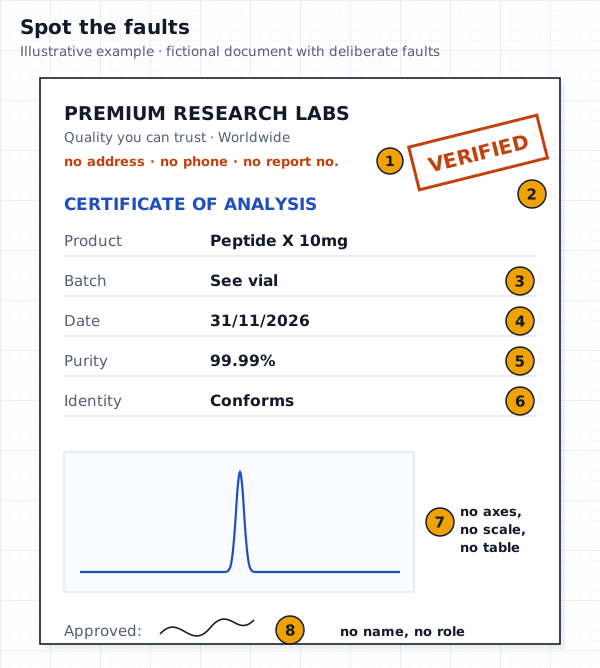
The twelve flags below fall into three groups: the document, the data and the context. Fig. 1 shows a fictional certificate with eight of them built in.
Flags in the document
1. No street address, phone number or report number
A genuine report identifies the laboratory and itself. Without an address and a unique report number there is nothing for the lab, or you, to check against.
2. A laboratory you can't find anywhere else
Search the lab's name. If it has no website, no listing on a business register such as ABN Lookup for an Australian entity, and no presence outside the seller's own pages, the "lab" may not exist.
3. An accreditation logo with no number, or a number that doesn't check out
Accreditation marks are images. Search the number in NATA's Find Organisation tool or the relevant overseas register, check the status is active, and check the test is in scope. NATA doesn't permit its endorsement on reports of testing outside the scope of accreditation.
4. Dates that don't work
Look for impossible dates (31 November), a test date before the batch was made, a report issued before the sample was received, or a COA years older than the product it is supposed to cover.
Flags in the data
5. A headline purity with nothing behind it
A purity of 99.99% isn't impossible, but it should come with a chromatogram and peak table that show it. For scale, European rules for peptide medicines require peptide-related impurities to be reported above 0.1% (EMA guideline on synthetic peptides). A number with no trace is a claim, not a result.
6. Identity reported as "conforms" or "passed"
Identity is a measurement: an observed mass compared with an expected mass, ideally with the spectrum. A single word with no numbers is not evidence that the right molecule is in the vial. Our note on how mass spectrometry confirms identity shows what a complete result looks like.
7. A chromatogram with no axes, scale or peak table
A real trace has a time axis, a response axis and integrated peaks listed in a table. A smooth curve without those is decoration.
8. The same chromatogram on different products or batches
Every run has its own baseline noise and small bumps. If two reports for different batches, or different peptides, carry an identical trace, at least one is copied. Lay them side by side and compare the small features, not the main peak.
9. A peak table that doesn't match the trace
Areas that don't add up to about 100%, a peak listed in the table with no peak in the picture, or a front-page purity that differs from the table all suggest the numbers were typed rather than exported. See how to read an HPLC chromatogram for a worked peak table.
Flags in the context
10. Batch missing, generic or mismatched
"See vial", "various", or a batch number that differs from your label means the report can't be tied to your product. A real batch COA names the batch it covers.
11. The seller's branding where the laboratory's should be
A COA laid out in the seller's colours with the seller's logo may be a summary the seller typed up, not a laboratory report. Ask for the original report from the lab and who ran the test.
12. Signatures, stamps and links that can't be traced
A scribble with no printed name or role, a "verified" or "certified" stamp that names no one, or a QR code that leads to the seller's website rather than the lab's all add decoration without adding evidence.
How forged COAs are usually made
Most forgeries come from one of three routes, and knowing them tells you where to look:
- An edited real report. A genuine COA from a real lab with the product name, batch number or result changed. The lab's details check out, so the enquiry to the lab is what catches it: the report number exists, but not with those contents.
- A template with no lab behind it. A professional-looking layout with an invented laboratory, or a real lab's name with made-up contact details. Searching for the lab on your own catches this one.
- A reused report. A genuine COA for one batch presented as covering another batch or product. Matching the batch number and comparing reports across products catches it.
The checks in this note are built around those three routes, which is why they focus on traceable details rather than on how polished the document looks.
Why fakes take this shape
The World Health Organization defines falsified medical products as those that deliberately misrepresent their identity, composition or source, and notes they are often sold online. A certificate is cheap to forge and is often the only quality evidence a buyer sees, so forgers concentrate on making it look right rather than making it checkable. That is why checking traceable details works.
Fake paperwork is only one part of the problem. Peptide Testing Australia's article on fake and contaminated peptides covers the related issue of products that are mislabelled, underdosed or contaminated even when the paperwork looks fine.
What to do if you spot a red flag
- Don't rely on the document while the question is open.
- Verify it with the issuing lab, using our step-by-step method.
- If the lab can't or won't confirm it, treat the COA as unverified.
- If the document appears forged and the product is being supplied in Australia, report it through the TGA's report-a-problem pages, keeping the COA and label as evidence.
Questions
How to tell if a peptide COA is real?
Check that it names a laboratory you can find on your own, carries a unique report number and batch, shows a chromatogram and an observed mass, and that any accreditation number is on the register. Then ask the lab to confirm the report; that confirmation is what proves it.
Can a COA be faked?
Yes, easily. Logos, layouts and numbers can be copied from real reports or invented. That is why the checks that matter are the ones a forger can't control: the register entry and the laboratory's own records.
Is a COA supplied by the seller good enough?
It can be, if it is a laboratory's report for the batch you hold and the laboratory confirms it. A seller-branded summary with no laboratory details is not the same thing.
What should I do with a COA I think is fake?
Stop relying on it, try to verify it with the named laboratory, and keep a copy. If it is attached to a product being supplied in Australia, you can report it to the TGA.