An HPLC test separates a sample into its components and measures each one as it leaves a column, which makes it the standard way to estimate a peptide's purity. It shows how much of the detected signal belongs to the main compound; it does not, on its own, prove which compound that is, how much peptide the powder contains, or whether the material is free of endotoxin and microbes.
That gap between what HPLC shows and what readers assume it shows is the main reason "HPLC tested" on a label tells you less than it seems.
What is HPLC?
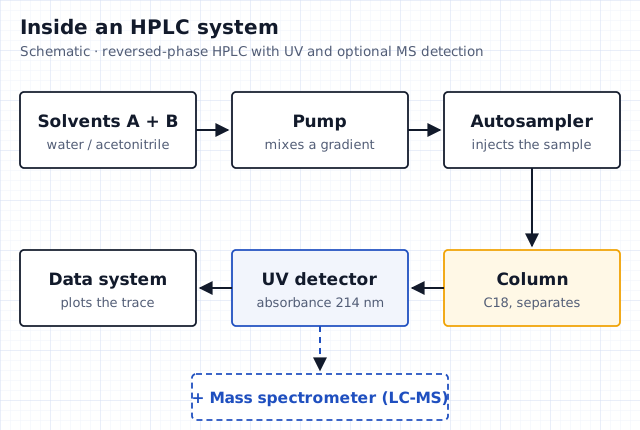
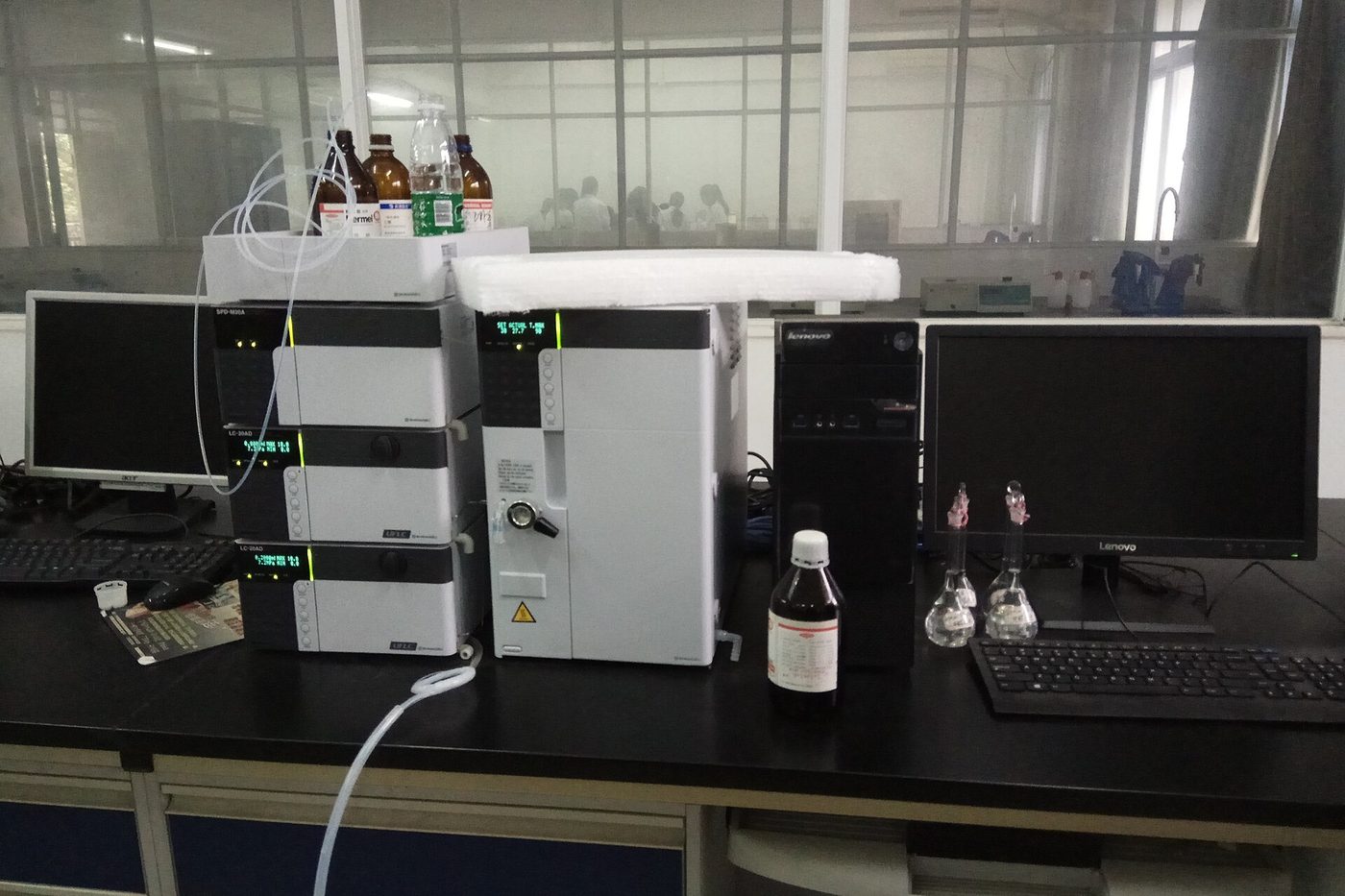
HPLC stands for high-performance liquid chromatography. A pump pushes a liquid, the mobile phase, through a narrow column packed with fine particles, the stationary phase. The sample is injected into the flowing liquid, and each compound in it travels through the column at its own speed depending on how strongly it interacts with the packing. A detector at the outlet records each compound as it emerges, and software draws the result as a chromatogram.
Reversed-phase chromatography is the more common form of HPLC: the stationary phase is non-polar, typically C8 or C18 hydrocarbon chains, and the mobile phase is polar, usually buffered water with methanol or acetonitrile. The most popular HPLC detectors measure UV or visible absorbance, and a mass spectrometer can be connected after the column instead of, or as well as, a UV detector.

What an HPLC test shows on a peptide COA
On a peptide certificate of analysis, HPLC is normally used to report purity: the main peak's area as a percentage of all integrated peaks at a UV wavelength near 214 nm, where peptide bonds absorb. A good report also lists the individual impurity peaks, so you can see whether 2% of impurity is one compound or twenty small ones. Our note on reading an HPLC chromatogram walks through the trace and the peak table.
HPLC can contribute to identity as well, but only with a reference standard. If the main peak comes off at the same retention time as a known standard of the peptide, run on the same method, that supports identity. The European Medicines Agency's guideline on synthetic peptides accepts relative retention time as one identification method, while recommending at least two orthogonal methods in total. Without a standard, a retention time is just a number.
HPLC can also give an assay, a measure of how much peptide is present, when the lab calibrates against a reference standard of known content. Many consumer-facing COAs don't do this, and report area percent purity only.
What HPLC misses
Each of the questions below needs a different test. A COA that answers only the first one is a purity report, not a full quality report.
| Question | Answered by HPLC-UV purity alone? | What answers it |
|---|---|---|
| How much of the UV signal is the main peak? | Yes | HPLC area percent |
| Is the main peak the right molecule? | No, unless matched to a reference standard | Mass spectrometry; a second orthogonal method |
| How much of the powder is peptide? | No | Assay against a standard, amino acid analysis, nitrogen analysis or qNMR |
| How much counter-ion (e.g. TFA) and water? | No | Counter-ion and water content tests |
| Are impurities hiding under the main peak? | Not always | A second separation method or LC-MS |
| Is endotoxin present? | No | LAL or recombinant reagent endotoxin assay |
| Is it sterile? | No | Sterility or microbiological testing |
The methods in the right-hand column come from the EMA guideline's list of specification tests for peptide active substances, which includes assay or content by LC, elemental analysis, amino acid analysis, nitrogen analysis or quantitative NMR, plus counter-ion content, residual TFA, water, bacterial endotoxins and microbiological purity.
What "HPLC tested" on a label means
"HPLC tested" means someone ran the material on an HPLC system, almost always to estimate purity. The phrase doesn't say who ran it, when, on which batch, against what specification or with what result. Treat it as an invitation to ask for the certificate, then check that certificate the way the front-page briefing describes.
How medicine regulators treat HPLC purity
Regulated peptide medicines are held to impurity limits measured in tenths of a percent. Under the European Pharmacopoeia thresholds that the EMA guideline applies, peptide-related impurities are reported above 0.1%, identified above 0.5% and qualified above 1.0%. In the United States, an FDA presentation on its guidance for generic synthetic peptides such as glucagon, liraglutide and teriparatide states that, for any new impurity in the proposed generic, a level above 0.5% is not acceptable and new impurities between 0.10% and 0.5% must be identified, characterised and justified.
Against that background, an HPLC purity of 95% means up to 5% of the UV signal comes from other compounds, each of which could be well above the levels medicine regulators track. That doesn't make every 95% result dangerous; it means the number needs context: which impurities, how many, and what else was tested.
Endotoxin: the test HPLC can't replace
Bacterial endotoxins are lipopolysaccharides from the outer membrane of gram-negative bacteria. FDA's inspection guide notes that they are difficult to remove from products once present and that filtration has limited effect in removing them. They are not detected by a UV purity method, so a peptide can show a clean chromatogram and still carry endotoxin.
Endotoxin is measured with a Limulus amebocyte lysate (LAL) test, in forms such as gel-clot, turbidimetric and chromogenic assays, or with recombinant reagents. FDA says its March 2026 revision of the pyrogen and endotoxins guidance removed certain references to LAL testing to accommodate a broader scope of recombinant reagents. A COA that reports endotoxin should name the method and give the result in endotoxin units (EU) per mg or per mL.
Where a vial-level test fits
If you hold a vial and the paperwork can't be verified, a vial-level HPLC and mass spectrometry test answers the two questions most buyers have first: is it the right peptide, and how pure is it? It is worth being clear that such a test is an identity and purity test, not an endotoxin or sterility test, and that a good result doesn't make an unapproved substance safe to use.
Questions
What is an HPLC test?
An HPLC (high-performance liquid chromatography) test pumps a dissolved sample through a packed column so its components separate, then measures each one as it leaves. For peptides it is mainly used to estimate purity from peak areas.
Can HPLC tell which peptide is in a vial?
Only indirectly. A matching retention time against a reference standard supports identity, but different compounds can come off at similar times. Mass spectrometry is the usual way to confirm which molecule the main peak is.
Does HPLC detect bacteria or endotoxin?
No. A UV purity method doesn't detect endotoxin or microbes. Endotoxin needs an LAL or recombinant reagent assay, and sterility needs microbiological testing.
Is a higher HPLC purity always better?
A higher purity means less of the UV signal comes from other compounds, which is generally good. It says nothing about identity, peptide content, counter-ions or endotoxin, so a high number on its own is not a full quality picture.
Sources
- Harvey, Analytical Chemistry 2.1: High-performance liquid chromatography (LibreTexts)
- European Medicines Agency: Guideline on the development and manufacture of synthetic peptides
- US FDA: Assessing immunogenicity risk of peptides, the synthetic peptide guidance (presentation)
- US FDA: Bacterial endotoxins/pyrogens inspection technical guide
- US FDA: Pyrogen and endotoxins testing, questions and answers (March 2026)