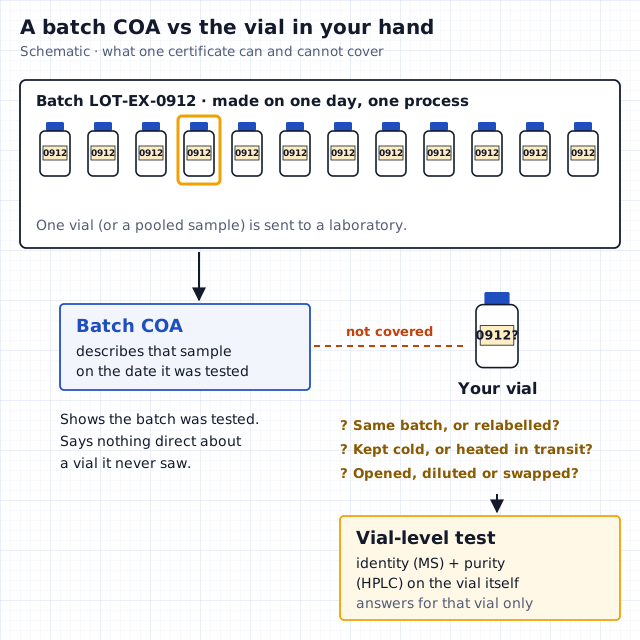
A batch COA reports on a sample taken from a production batch; it doesn't test, and can't vouch for, the particular vial you hold. Even when the certificate is genuine and verified, your vial may come from a different batch, may have been relabelled, or may have changed since the batch was tested, and only a test on that vial answers for that vial.
This note explains what a batch COA covers, what can differ between the tested sample and your vial, and when a batch report is a reasonable basis for confidence.
What a batch COA is
A batch is material made together, in one run of one process. The manufacturer or seller sends a sample from it, sometimes one vial and sometimes a pooled sample, to a laboratory, which tests it and issues a report naming the batch. That report is then shared with buyers of vials from the batch.
The laboratory's statement is precise: a well-made report says its results relate only to the sample received. Everything beyond that, including the idea that every vial in the batch is the same, rests on the manufacturer's process and record-keeping rather than on the test.
Why one sample can't speak for another vial
For regulated medicines, consistency between units is built in through manufacturing controls, validated processes and specifications that are tested at release and through stability studies. The European Medicines Agency's guideline on synthetic peptides shows how much of that framework exists, from impurity thresholds to stability-indicating methods. Peptides sold outside the medicines system usually come with none of it visible to the buyer, so the batch COA is doing more work than it was designed for.
Several things can break the link between the tested sample and your vial:
- Different batch. The COA covers batch A; your vial is from batch B, or carries no batch number at all.
- Relabelling. Material from another source has been relabelled with a batch number that has a good COA.
- Selective sampling. The sample sent for testing was not representative of the batch.
- Handling after testing. Storage, transport or repackaging changed the product after the test.
What can change after the batch was tested
Peptides are not inert. The EMA guideline asks manufacturers to discuss a peptide's potential degradation pathways, giving oxidation of cysteine and methionine residues, deamidation and hydrolysis as examples, which is why medicines carry stability data and storage conditions. A batch tested on one date tells you about the sample on that date; it can't account for how your vial was kept since.
Contamination is the other risk. Endotoxins, for example, are hard to remove once present: FDA's inspection guide notes that filtration has limited effect in removing them. Repackaging or opening vials outside controlled conditions can introduce problems the original batch never had.
Batch COA and vial test compared
| Batch COA | Vial-level test | |
|---|---|---|
| Who chose the sample? | The manufacturer or seller | You |
| What does it describe? | The sample the lab received from the batch | The vial you send |
| When does it describe it? | On the batch test date | On the date your vial is tested |
| Covers relabelling or mix-ups? | No | Yes, for that vial |
| Covers changes since manufacture? | No | Up to the test date |
| Covers other vials? | Only through the seller's process | No |
| Cost to the buyer | Usually none | Paid per vial |
When a batch COA is enough
A batch COA is a reasonable basis for confidence when all of these hold: the laboratory has confirmed the report, its accreditation and scope check out, the batch number on the report matches your label exactly, the product came through a supply chain you can trace, and the report covers both identity and purity. If any link is missing, the certificate tells you less about your vial than it appears to.
It is rarely enough when the batch number is missing or different, the lab won't confirm the report, the same report appears across several products, or you have no idea how the vial was stored or shipped.
Questions to ask about a batch COA
- Which batch does this report cover, and is it printed on my vial's label?
- Who chose the sample sent to the lab, and was it a single vial or a pooled sample?
- When was the batch made, and when was it tested?
- Does the report include identity as well as purity, with the chromatogram and mass spectrum?
- Will the laboratory confirm the report if I contact it?
A seller who holds a genuine batch report can usually answer all five quickly. Vague answers to the first two are the most telling, because they are about whether the report has anything to do with your vial at all.
Reading the batch number
Batch or lot numbers are the link between paperwork and product, so read them character by character. A COA for LOT-0912 doesn't cover a vial marked LOT-0921. A vial with no batch number can't be matched to any batch COA, however genuine the report. A label that looks reprinted or stuck over another label is worth photographing before you open the vial.
What a vial-level test covers
A vial-level test removes the chain-of-custody question by testing the material itself. Peptide Testing Australia, for example, tests samples posted from within Australia for identity by mass spectrometry and purity by HPLC through accredited laboratory partners, and issues one plain-English COA per vial; its standard price is A$575 per vial including GST, with periodic discounts, and its vial testing page gives a turnaround of about 5 to 7 business days plus postage.
A vial test has its own limits. It describes the vial tested and no other, it reports identity and purity, not endotoxin or sterility, and a good result doesn't make an unapproved substance safe to use. Reading the result well matters as much as ordering it; our notes on chromatograms and mass spectrometry cover what to look for.
Questions
Does a batch COA cover every vial in the batch?
Not directly. It reports on the sample the laboratory received. Other vials are covered only to the extent the manufacturer's process kept the batch consistent, which buyers usually can't see.
How long is a peptide COA valid?
A COA doesn't expire in the way a licence does; it describes a sample on the date it was tested. The older the report, the less it can say about material that has been stored or shipped since.
Why would a genuine COA not match my vial?
Your vial may be from a different batch, may have been relabelled, or may have changed in storage or transit. The COA can be accurate about its own sample and still say nothing reliable about your vial.
Can I get my own vial tested in Australia?
Yes. Some services accept vials posted from within Australia and test them for identity and purity, issuing a COA for that vial. Check what each test covers, because identity and purity tests don't include endotoxin or sterility.